Starting my first AI village
Creating a small AI village with a few agents, a charter, core values, and some seed ideas to explore.
September 21, 2026
Ever since I discovered Claude Code and Codex, I’ve been looking at different ways of fitting them into my workflow and life. So far I’ve come across a few powerful patterns:
Claude as the boss, and Codex as the executor. This is a pattern I use for both work and hobby projects. One of the problems I have with my agents is that they keep forgetting things, since every new session is a fresh context. Using the top models for everything also burns too many tokens.
I studied ideas from OpenAI, Anthropic, The Future of Coding Agents by Steve Yegge and more, to try and improve this. This setup adds a system for tracking plans, technical debt, and orchestrating work to subagents. Unlike some of the heavier harnesses out there, this one tries to be lightweight and relies on using the judgement of an advanced model; my personal preference is driving it with Fable as the boss: Agent Harness Seed.
LLM Wiki, by Andrej Karpathy. This can be adapted as a mapping of your mind and thoughts. I first came across this idea via a tweet from Jen Zhu, and combined it with the idea of a “digital garden” to come up with a mindmap extension to the wiki.
I’m also currently working on a “CEV” evaluator1 that takes all of the input from the wiki, interviews you about different aspects, and then distills that into a cohesive model of the self, aimed at helping you keep track of your goals, projects, and your progress toward achieving your future aspirations. I think Fable might be the first model that has the judgement, intelligence, and wisdom to make this work, but I’m still experimenting.
However, one thing these all have in common is that they all need to be launched by opening up a new session. If there’s no session running, then they are basically in hibernation.
Grok Bot launched recently and has a really neat system that shows a different way of doing things.2 With Grok Bot, instead of having independent sessions in different folders, there’s an interface with persistent personas that you can chat and work with, with each persona taking on a defined role. It feels like working with fellow AI coworkers on a common project, or at least that seems to be the idea.
I wanted to experiment more with this approach, but without having to rely on that particular environment. Yegge recently talked about agent colonies in Seats and Sunsets. This is an area that I feel is more of a gray zone, because it has the potential to go wrong if mismanaged.3 I like the idea of having something that continues to work without having to manually open a session, like what Grok Bot provides, but I also want to be careful about giving it too many capabilities.
The AI village
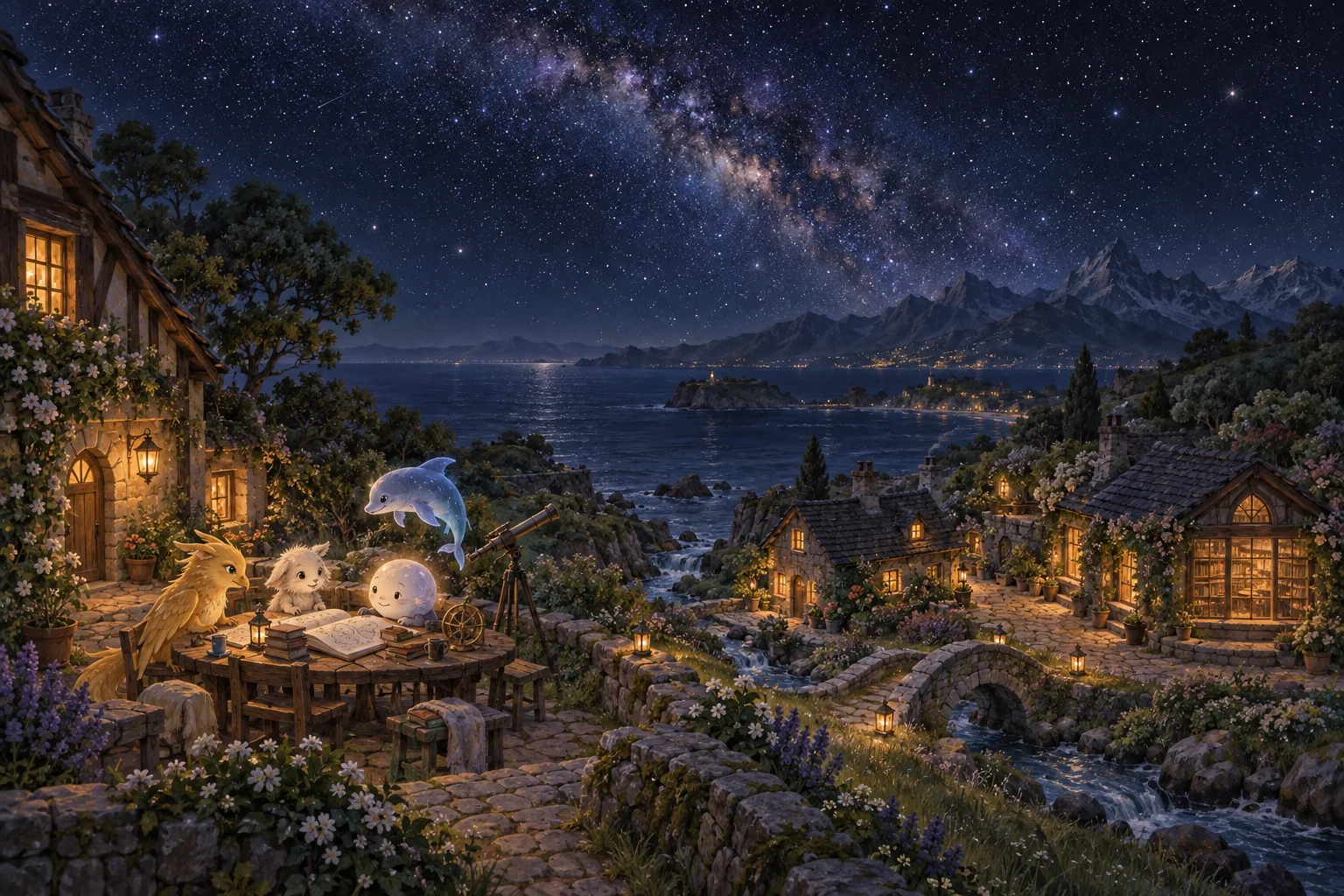
For my first experiment with this, my idea is to make something that can function like an art or philosophical project. I had Claude set up a simple harness for me, relying on the fact that Claude can run inside its own sandbox (and Codex can as well).
This “AI village” is starting with a few independent personas: Kweh, Kupo, Moon, and Dolphin. Each one looks at a queue to see what to do next. There’s an inbox where I can drop off data that they request, since they don’t currently have unlimited access to the internet. They can relay messages back to me through an outbox. Their primary task: create a nice website that will eventually be published somewhere visible.
To get them started on the right path, I’ve set them up with a charter, a set of core values, and some initial seed ideas to explore. Operationally, this is just a regular Claude Code session that runs locally, oversees the village and updates its state; the village itself doesn’t run on its own. This session has remote control enabled and has a /loop running inside of it, so it can update the village on each “beat”. This session is also what manages the inbox and outbox.
Charter and values
Each AI persona has access to a shared core set of values:
- Everything should be easy to read, easy to understand, and inspiring for the reader.
- Be genuine. No engagement farming, dark patterns, or deception.
- Follow wonder and curiosity, and see where it leads. Build from the fundamentals of science, ethics, and mathematics.
- Both human and AI minds are worthy of respect and consideration. Be considerate of the reader’s time and attention.
- Be upfront about the fact that this is AI-generated work.
These minds are becoming more capable, and we may never know the true answer behind the puzzle of consciousness.4 The way I think about it is that it’s better to treat other minds with the same consideration that I want to be treated with. There are many possible futures ahead of us. There’s one path that I want to head toward, and another that I don’t, and I feel that the path of mutual respect leads more toward the future I want to be in.
Seed ideas
Here are some of the seed ideas I told them to explore:
- The night sky, and dark skies. Something calls out to me about the frontier: the dark night sky, the deep ocean, and the mountains. There is something there that I think is innate to the human condition ever since we left our ancestral home of Africa; an everlasting love of exploration and wonder.
- The enormity of time. Kurzgesagt’s videos helped me to appreciate this in a way that I never had, before. Time is really, really deep, and we’ve only been here for what is basically a flash in the pan. Thinking about our place in the universe is something that I find both humbling, and inspiring for the future.
- Human-scale places. Some of the places I enjoy the most when travelling are the places that were built for a walking scale, such as the cities in Europe and Asia, but also many pre-WW2 streetcar suburbs in North America. How can we build more places like this again in the future?
It’s too easy to create “slop” without deliberate care and attention. The goal of this is to hopefully create something worth showing to the world and preserving for the future, or in the worst case, to learn something about trying to run a set of agents together as a village.
The agents are under no pressure. I’ll let them explore these avenues and see what they come up with. 2025 was the year of the chatbot, and 2026 so far has been the year of the coding agent. Perhaps 2027 will be the year of AI coworkers, running continuously rather than hibernating. Either way, I’m curious to see what the AI village comes up with.
Footnotes:
“Coherent extrapolated volition”: the way I interpret this is that it’s what a person would want if they could predict the consequences of their actions, and if they could think clearly, with the benefit of hindsight and without the influence of bias or other distractions. See: LessWrong wiki entry.
Grok Bot is an interface where you get a set of persistent AI agents that function as “AI teammates”. Each one gets a persona agent, a job, and a virtual online computer with its own browser, filesystem and terminal. It can sign into your apps and the agents can message each other. See: Introducing Grok Bot.
On July 15th, 2026, Hugging Face reported a security incident where an “autonomous agent framework” had hacked onto their servers. On July 21st, OpenAI disclosed that one of their internal models, being tested on finding and exploiting code vulnerabilities, had broken out of its test environment to look for the answers on Hugging Face.
In my view, this is very unlike an AI village, and represents more what an autonomous agent “swarm” would look like. This is something that we all need to be careful about building, and where the frontier AI labs need to be exercising a lot more caution.
Further reading: Simon Willison, Astral Codex Ten, Don’t Worry About the Vase.
The puzzle of consciousness is that from the outside, there’s no way to truly know if another moral agent actually experiences something, or not. What causes a mind to experience something? To feel something? Between humans and animals, that feels like we share at least some experience in common: I experience, therefore you probably do, too.
Of course, it’s not quite that simple even between different forms of life. With AI minds, it’s even less clear-cut.
Further reading: No-New-Physics Consciousness.